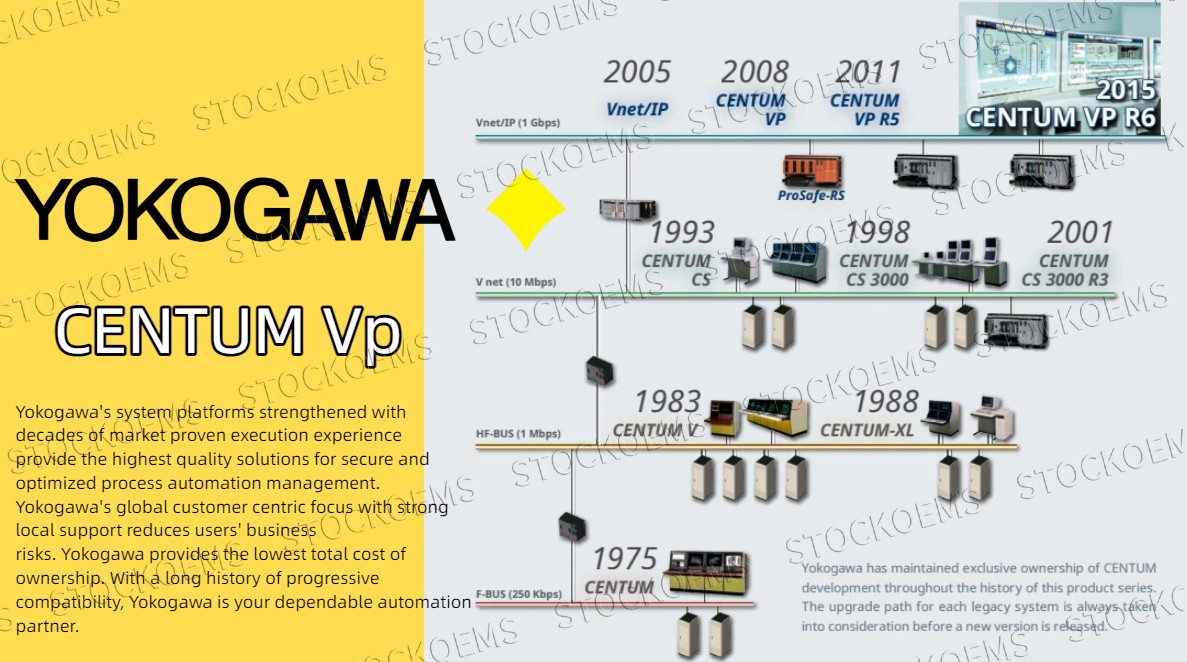
Integrating three major areas, Yokogawa CENTUM VP redefines integrated operations
Yokogawa's CENTUM Series, through its core CENTUM VP system, innovatively integrates three key areas—production operations, safety instrumentation, and asset management—onto a unified platform. This system employs cognitive vision integration technology, converging alarm information and data streams from distributed control systems (DCS), safety instrumented systems (ProSafe-RS), and plant resource management (PRM) systems onto a unified operator station (HIS) interface. This deep integration breaks the traditional model of multiple systems operating independently, enabling operators to gain a panoramic view of the plant's status and achieving a true organic unity of production excellence, safety excellence, and asset excellence. Based on decades of expertise accumulated in the process industries, the CENTUM Series constructs a human-centered human-machine interface. Its flexible multi-monitor window design can be customized to different operational needs, and the ergonomically optimized graphical interface, through scientific color matching and contrast adjustment, ensures clear visibility of information under various ambient lighting conditions. The wisdom of operational experience is integrated into the display configuration, ultimately translating into optimally presented data on the screen, empowering operators to make quick and correct decisions.
To ensure the continuous and stable operation of modern factories, Yokogawa's CENTUM series constructs a comprehensive dual-redundancy architecture from controller to network. The processor modules, power supplies, input/output modules, and even the control network of the field control stations (FCS) are all configured in dual-path configurations, forming the physical foundation of the system. Its unique "paired and standby" working mechanism ensures that the primary and standby processor modules operate synchronously and continuously compare outputs. When a fault caused by electronic noise or other anomalies is detected, the system can seamlessly switch to the standby module, minimizing the impact on process control. Even in the event of a hardware failure, the corresponding module can be replaced online without interrupting production. The Vnet/IP control network on which the system relies is built based on Gigabit Ethernet technology, combining redundancy and security, supporting star and ring topologies, and providing real-time communication guarantees refreshed every second for stable operation throughout the plant, regardless of project size and complexity.
Facing the challenges of technological iteration and system upgrades, Yokogawa's CENTUM series introduces virtualization technology, separating system software operations from physical hardware dependencies. This innovation means that software assets have high reusability and can be optimally deployed on new hardware platforms. For customers, this directly translates into core business-centric benefits: significantly reduced downtime, smooth hardware migration with shortened migration and system testing cycles. From a maintenance perspective, the separation of hardware and software maintainability also brings significant advantages. Simultaneously, Yokogawa's "Advanced Operational Graphics" consulting service integrates human factors engineering and knowledge engineering, analyzing factory operational tasks and reflecting the results in graphical interface design. This service focuses on factors such as color selection, layout, and visual functionality, aiming to provide intuitive situational awareness, thereby facilitating early anomaly detection, accelerating decision-making, reducing operational errors, alleviating operator stress, and transforming tacit operational skills into explicit knowledge transfer. The specially designed single-loop and eight-loop simultaneous operation keyboard, with its optimized function key layout, allows operators to access screens or switch control loops with a single keystroke, enabling rapid response to process changes.
Yokogawa's CENTUM series not only provides a solid hardware foundation but also features powerful and flexible control functions and maintenance tools. The CENTUM VP controller itself boasts powerful processing capabilities and a large application storage capacity, fully leveraging the advantages of advanced field digital technology to help factories achieve better efficiency, safety, and stability. The system offers a rich library of function blocks covering monitoring, control, computation, logic, and sequential control, supporting continuous control, advanced control, complex sequential control, and batch control. All these functions can be executed in a redundant, safe, and reliable control environment. By combining these control blocks, process control systems can be designed flexibly, scalably, and modularly. Most importantly, the system's online maintenance function allows users to modify application logic and parameters without stopping FCS control. This enables factories to expand or upgrade online, ensuring that production operations remain unaffected and ultimately helping users achieve lower total cost of ownership and higher operational reliability.
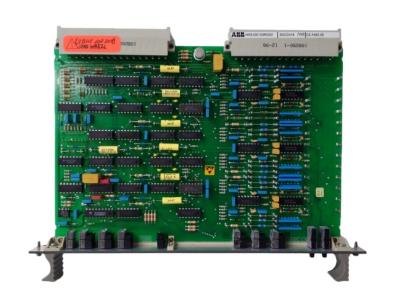
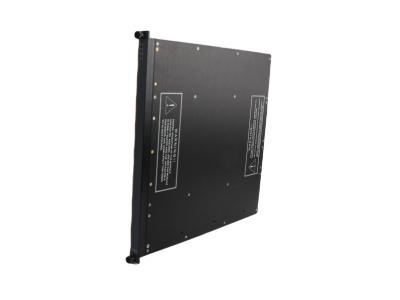
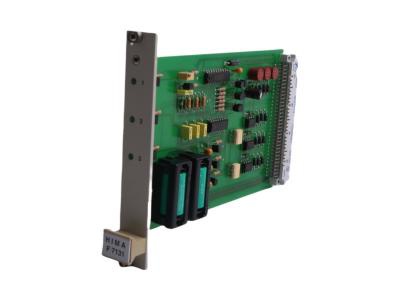
Recommended model
| ANT411-50 S1 | ADV141-S12 S1 | ADV151-E63 S2 |
| NFDV161-P01 S2 | AAT145-S53 S1 | ADV151-P00 S2 ATD5A-00 |
| NFAI135-S51 S2-1 | AAT141-S50 S2 | ADV151-P03 S2 |
| ADM52-2 S4 | ADV142-P10 S1 | ADV151-P50 S2 |
| ADR541-P10 S1 | ADV142-P13 S1 | ADV159-P00 |
| ADR541-P11 S1 | ADV142-S02 S1 | ADV151-P53 S2 |
| ADR541-S00 S1 | AFV10D S2 | ADV161-P00 S2 |
| ADV141-P10 S1 | ADV142-S03 S1 | ADV161-P50 S2 |
| ADV141-P12 S1 | ADV151-E50 S2 | ADV551-P00 S2 |
| ADV141-P13 S1 | ADV151-E60 S2 | ADV551-P03 S2 |
If you want to know details, please contact me without hesitate.