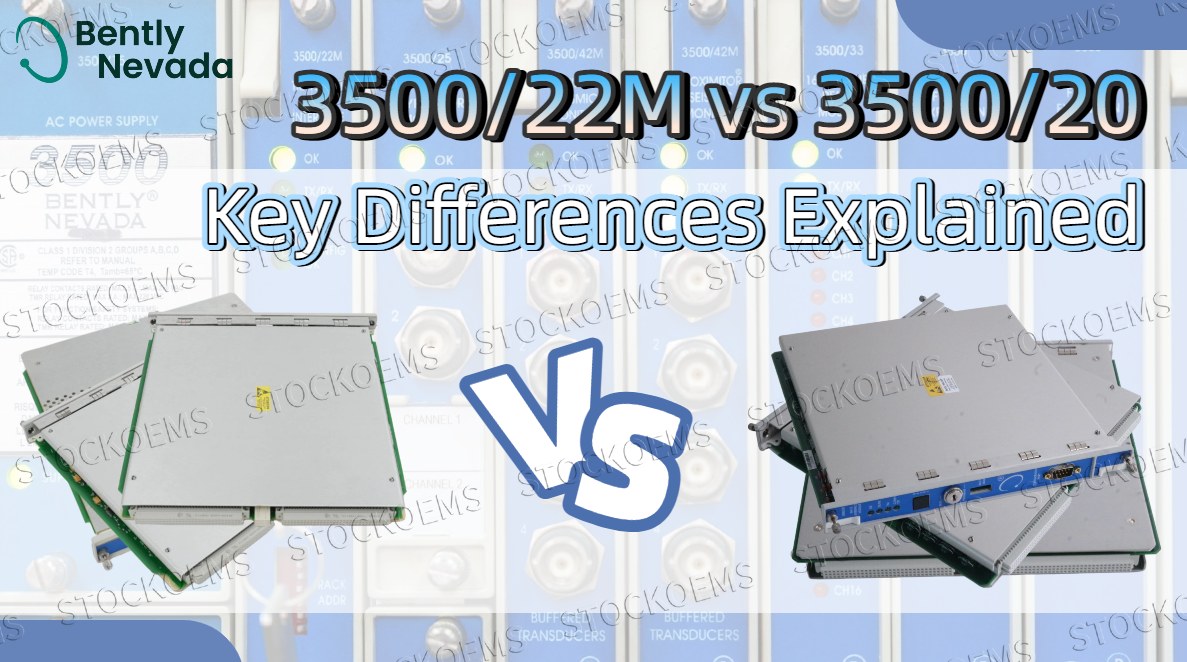
The Bently Nevada 3500/20 and 3500/22M both serve as the main interface for the 3500 rack, but their data and communication capabilities differ significantly. The 3500/20 is mainly designed for rack configuration and serial communication, while the 3500/22M adds Ethernet connectivity and integrated transient data acquisition. Understanding these differences helps maintenance teams select compatible automation spare parts for machinery protection systems.
What Are the 3500/20 and 3500/22M?
The 3500/20 Rack Interface Module
The Bently Nevada 3500/20 Rack Interface Module, or RIM, is the primary interface for configuring the 3500 rack and retrieving machinery information. One module is required per rack and must be installed in Slot 1 next to the power supplies.
The 3500/20 supports rack reset, Trip Multiply, alarm inhibit and configuration control. It mainly communicates through Bently Nevada proprietary protocols using RS232 or RS422 connections at up to 38.4 kbaud. RS422 communication can also connect multiple racks over distances of up to 1,200 metres.
Advanced static and dynamic data collection generally requires an external processor such as TDXnet, TDIX or DDIX. Although the RIM provides rack-wide functions, it is not part of the critical monitoring path and does not directly affect normal machinery protection operation.
The 3500/22M Transient Data Interface
The Bently Nevada 3500/22M Transient Data Interface, or TDI, combines the functions of the 3500/20 with the data acquisition capabilities of an external communication processor. It communicates with M-series monitors, including the 3500/40M and 3500/42M.
Static data collection is standard. With the appropriate dynamic-data enabling option, it can also capture waveforms and high-resolution transient data. The information is transferred to System 1 Condition Monitoring and Diagnostic software or 3500 System Configuration software.
This integrated design makes the 3500/22M an important part of modern Bently Nevada 3500 Machinery Protection Systems and Online Condition Monitoring applications.
What Are the Main Differences?
Data Collection Capability
The 3500/20 primarily handles rack configuration and communication. Dynamic data normally passes through a separate external communication processor.
The 3500/22M collects steady-state and transient information directly from the rack. It supports waveform collection from up to 48 channels, including synchronous and asynchronous sampling. Engineers can use this information to analyze vibration amplitude, phase, spectrum and orbit data.
During an alarm, the TDI records pre-alarm and post-alarm information. It can also collect startup and coastdown data according to programmable machine speed and time intervals. These capabilities help engineers identify problems that may only appear during changing operating conditions.
Serial Communication vs Ethernet
The 3500/20 uses RS232 and RS422 serial communication. This arrangement remains suitable for many legacy systems but offers limited bandwidth for transferring large volumes of diagnostic data.
The 3500/22M supports USB-B for local configuration and Ethernet for network communication. Copper versions provide autosensing 10Base-T or 100Base-TX connections with a maximum cable length of 100 metres. Fibre-optic versions support 100Base-FX communication over distances of up to 2,000 metres.
Ethernet allows the 3500/22M to transfer waveform and transient data efficiently to condition-monitoring software. Fibre is particularly useful in large plants where long distances or electrical interference may affect copper networks.
Physical and Power Requirements
Both modules occupy one full-height front slot and require one full-height rear I/O slot. The 3500/22M measures approximately 241.3 × 24.4 × 241.8 mm and weighs about 0.91 kg.
The 3500/20 typically consumes 4.75 watts, while the 3500/22M requires approximately 10.5 watts. When sourcing Bently Nevada Protection and Sensing Hardware, users should verify the rack power supply, rear I/O module and installed monitor revisions rather than comparing only the front module numbers.
Which Module Should You Choose?
When to Retain the 3500/20
The 3500/20 remains suitable for established systems that only require rack configuration, serial communication and basic machinery information. It may also be retained where compatible external communication processors are already operating reliably.
Some Triple Modular Redundant systems require a dedicated TMR version of the 3500/20. Because this version performs monitor channel comparison, it should not be replaced with a standard 3500/22M without an engineering review.
When to Select the 3500/22M
The 3500/22M is the better option when a facility requires System 1 integration, Ethernet communication, waveform collection or transient event analysis. It is particularly useful for turbines, compressors, pumps and generators where startup, coastdown and alarm records support effective Machinery Protection and fault diagnosis.
Before ordering, users should confirm the required dynamic channel capacity, Ethernet type, agency approvals and compatibility with existing M-series monitors.
Important Upgrade Requirements
Replacing a 3500/20 involves changing both the front module and its rear I/O module. The correct sequence is to remove the 3500/20, remove the old RIM I/O module, install the appropriate TDI I/O module and then insert the 3500/22M. Leaving the RIM I/O module installed can damage the new TDI.
Some earlier M-series monitor revisions may also be incompatible with the 3500/22M. An experienced industrial automation parts supplier should therefore verify the complete rack configuration before supplying these hard-to-find automation parts.
Conclusion
The Bently Nevada 3500/20 is a serial-based rack interface intended mainly for configuration and communication. The 3500/22M adds Ethernet networking, System 1 connectivity and integrated collection of steady-state, waveform and transient data.
The 3500/20 may remain practical for a stable legacy installation, while the 3500/22M is more suitable for modern condition monitoring. Correct selection depends on the installed monitors, rear I/O hardware, network type, software and required data capacity.
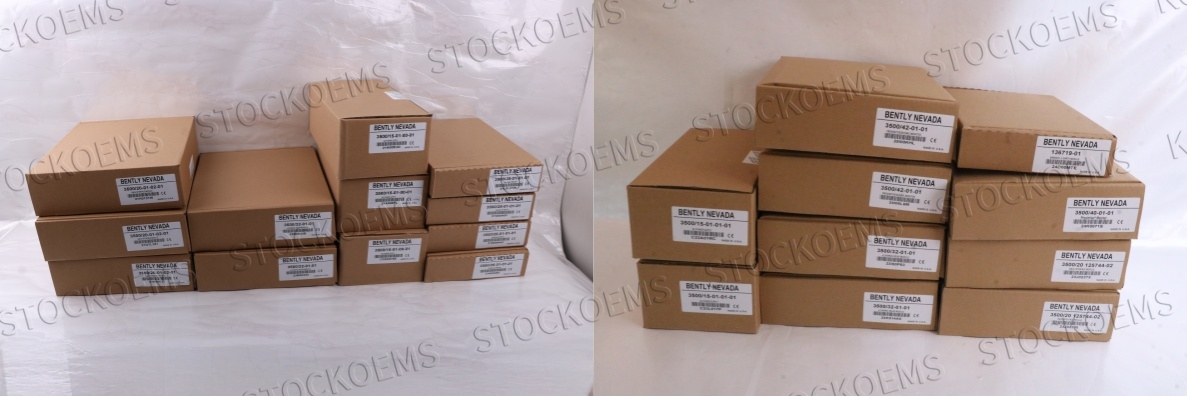
Recommended Model
|
3500/05-01-02-00-00-00 |
3500/05-02-04-00-00-01 |
3500/15 106M1079-01 |
3500/15 114M5330-01 |
|
3500/15 127610-01 |
3500/15 129486-01 |
3500/20 |
3500/20 125744-02 |
|
3500/22M 138607-01 |
3500/22M 288055-01 |
3500/23E |
3500/23E |
|
3500/25 149369-01 |
3500/25 149369-01 |
3500/32 125712-01 |
3500/32M |
|
3500/32M 149986-02 |
3500/32M 149986-02 |
3500/33 149986-01 |
3500/33 149986-01 |
|
3500/40 125672-01 |
3500/40M |
3500/40M 140734-01 |
3500/40M 176449-01 |
|
3500/42E |
3500/42E 289837-01 |
3500/42M 140734-02 |
3500/42M 176449-02 |
|
3500/42M 176449-02 |
3500/42M 176449-02 |
3500/44M 176449-03 |
3500/44M 176449-99 |
|
3500/45 |
3500/45 140072-04 |
3500/45 176449-04 |
3500/45 176449-04 |
|
3500/46M 176449-06 |
3500/50 |
3500/50 133388-02 |
3500/50E |
If you want to know details,please contact me without hesitate.