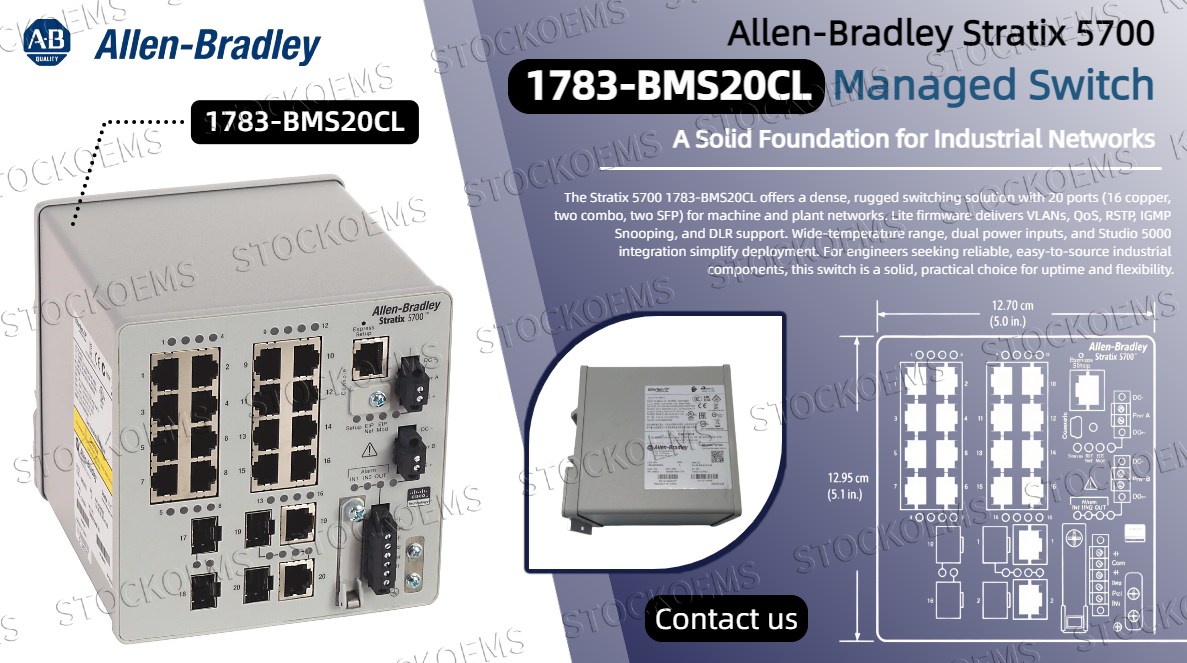
The Stratix 5700 1783‑BMS20CL gives you a practical, high‑density switching solution that balances port count, manageability, and physical toughness. Its 20 ports – 16 copper, two combo, two SFP – give you the connections you need for machine‑level and plant‑wide networks, with fiber options for longer reaches. The Lite firmware keeps configuration straightforward while delivering VLANs, QoS, RSTP, IGMP Snooping, and DLR support. Wide‑temperature operation, dual power feeds, and close integration with Studio 5000 make it a natural fit for new installations and retrofits alike. For engineers and integrators who need dependable industrial automation components that are easy to source, simple to deploy, and backed by a proven ecosystem, this switch stands as a solid, no‑nonsense choice for keeping production moving.
Twenty Ports, Real Flexibility for Machine‑Level and Plant‑Floor Connectivity
The Allen‑Bradley Stratix 5700 1783‑BMS20CL is a 20‑port managed industrial Ethernet switch built for the realities of factory and process automation. It gives you 16 Fast Ethernet copper ports, two combo ports that handle either copper or fiber SFP modules, and two dedicated SFP slots for fiber links. That mix matters when you need to connect PLCs, HMIs, servo drives, encoders, and other automation and control components across a machine or an entire production line. The fiber ports let you reach between remote cabinets or cover long distances across a plant without signal degradation. The switch runs on 12 to 48 V DC and pulls about 21 W at 24 V DC, so it fits easily into existing power schemes. Its compact footprint – 129.5 mm × 127 mm × 116.3 mm – and IP30 rating make it a natural fit for DIN‑rail mounting in control enclosures where every inch counts. If you are sourcing Allen Bradley automation parts for a new project or replacing legacy switches, this model gives you a field‑tested, reliable networking core that slides right into Rockwell Automation’s Integrated Architecture without extra engineering headaches.
The Management Tools You Actually Need, Without the Overhead
The 1783‑BMS20CL runs Stratix Lite firmware, which focuses on the Layer 2 features that matter most in industrial settings. You get VLANs to segment traffic and keep broadcast storms in check, IGMP Snooping to handle multicast traffic efficiently, QoS to prioritize time‑sensitive I/O and motion commands over background traffic, and RSTP to avoid loops and recover quickly from link changes. There is also port mirroring for diagnostics, SNMP for feeding data into network management tools, and ACLs if you need to filter traffic. The switch supports Device Level Ring (DLR) protocol, so you can build ring topologies that survive a single cable break – traffic just flips to the other path and keeps moving. You can set it up through the web‑based Device Manager, the CLI, or right inside Studio 5000 using the Logix Designer Add‑on Profile. That last option is a timesaver: predefined Logix tags and FactoryTalk View faceplates give you live diagnostic data straight from the controller. For maintenance teams stocking automation spare parts, this means less time spent on configuration and fewer calls to the control room when something looks off.
Built for the Shop Floor, Backed by Integrated Architecture
This switch is not a delicate IT device in a rugged box. It runs from –40 °C to +75 °C, so it handles freezers, foundries, and everything in between. Dual power inputs add a layer of fault tolerance – if one supply drops, the other takes over without a glitch. The alarm relay contacts can notify your control system about power or link failures, so you know about problems before operators do. The Lite firmware keeps things simple: it gives you the managed‑switch essentials without bogging you down with routing protocols you will never use in a machine‑level network. That makes it a strong candidate for cell‑area or equipment‑level applications where uptime and simplicity come first. Tighter integration with Logix controllers means you can manage the switch the same way you manage your I/O or drives. CIP Sync gives you precise time synchronization across devices, which helps with coordinated motion and event logging. As plants get more connected and data‑driven, these capabilities become less optional and more routine. Whether you are upgrading a process control line, expanding a distributed protection system, or putting in a new machinery protection setup, the 1783‑BMS20CL fits the bill without forcing you to redesign your whole network approach.
Recommended Model
|
1783-BMS10CL |
1783-EMS08T |
1783-ETAP |
|
1783-ETAP1F |
1783-MS10T |
1783-MX08T |
|
1783-US08T |
1784-KTCS |
1784-KTCX15 |
|
1784-KTX |
1784-KTX |
1784-KTXD |
|
1784-PCIC |
1784-PCIS |
1784-PCMC1 |
|
1784-PCMK |
1784-PKTS |
1784-PKTX |
|
1784-PM16SE |
1785-BCM |
1785-BCM |
|
1785-BCM/C |
1785-BEM |
1785-L20C |
|
1785-L20C15 |
1785-L20E |
1785-L40E |
|
1785-L40L |
1785-L60B/C |
1785-L80C |
|
1785-L80C15 |
1785-L80E/E |
1785-LT/B |
|
1785-LT3 |
1785-ME16 |
1785-ME32 |
|
1785-ME64 |
1785-PFB |
1785-V40L |
|
1785-V40V |
1785-V80B |
1786-BNC |
|
1786-CP |
1786-RG6 |
1786-RG6 |
If you want to know details,please contact me without hesitate.