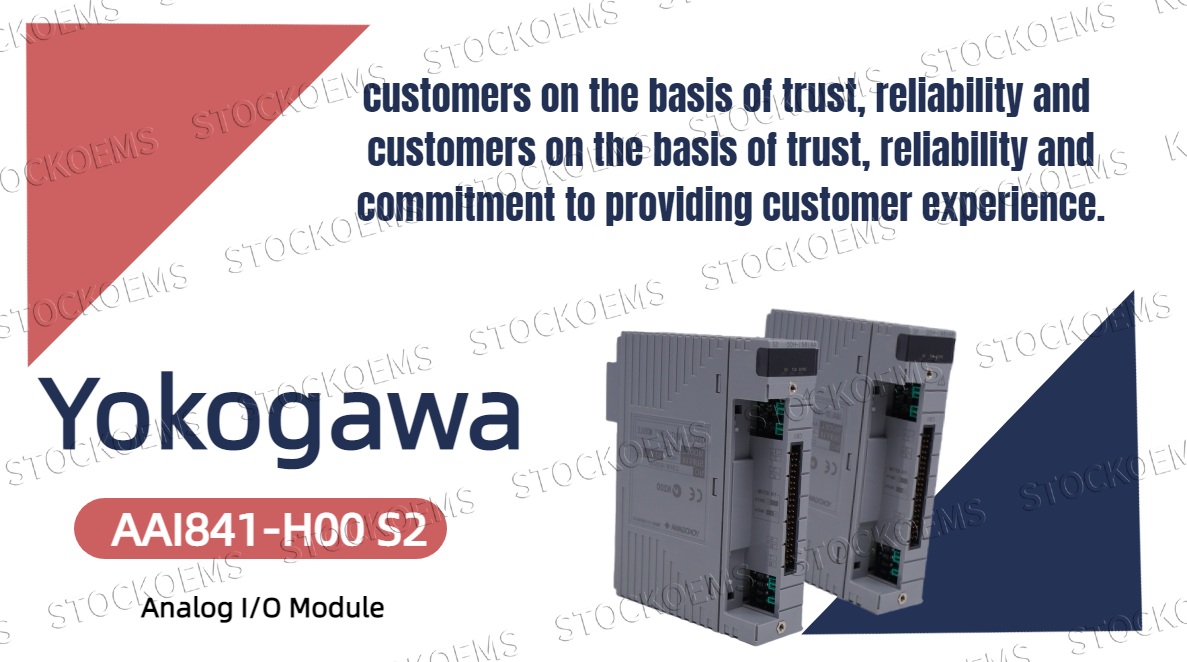
What is the Yokogawa AAI841-H00 Module
In the field of industrial automation, accurate and reliable analog signal processing is crucial for process control. So, what is the core component that undertakes this important task? The answer is the Yokogawa AAI841-H00 analog input/output module. This module is a non-isolated I/O module designed specifically for harsh industrial environments, primarily handling standard 4 to 20 mA current signals. Specifically, it provides 8 independent input channels and 8 independent output channels, capable of simultaneously handling both signal acquisition and command issuance. Where is this design suitable? It is widely used in continuous production process control systems in industries such as petrochemicals, power, and pharmaceuticals, serving as a crucial bridge between field instruments (such as transmitters and actuators) and upper-level control units (such as field control units, FCUs). When is this module typically deployed? As part of Yokogawa's FIO (Field Network Input/Output) system, the AAI841-H00 is installed in the base of the ANB series bus node unit during system integration or retrofitting, forming a crucial node in the distributed I/O network. Understanding its basic definition and positioning reveals that the AAI841-H00 is a fundamental hardware unit for building a highly available automation architecture.
How to Install and Configure the AAI841-H00 Module
After defining the module's role, engineers will inevitably ask: how to properly integrate it into the control system? The AAI841-H00's physical connections offer flexibility. Typically, it connects to field device cables via pressure-clamp terminal blocks, facilitating wiring and maintenance by field engineers. When terminal expansion is required, KS cable adapters can be used to connect the terminal block. If customers wish to use the included high-reliability MIL connector cables, the module also supports direct mating, providing convenience for specific application scenarios. How is reliability ensured in safety redundancy configurations involving critical processes? The module supports dedicated dual-redundant configuration terminal blocks, allowing for signal path backup through parallel configuration of two sets of modules, thereby maximizing system availability. The core of its configuration lies in correctly selecting the terminal blocks according to the type of field device being connected. For example, when connecting a two-wire transmitter, the signal should be connected to terminals A (+) and B (-) of a specific channel; while when connecting a four-wire device (independently powered), the positive current input should be connected to terminal B (selected via pin settings for 4-wire input mode), and the negative to terminal A. Incorrect wiring will lead to signal abnormalities; therefore, following the terminal connection specifications provided with the module is a crucial step for successful implementation.
Why is the AAI841-H00 module crucial in system integration
Having understood the installation method, we need to further explore: why does it occupy such a central position in the entire control system? Its importance is primarily reflected in the integration of the system architecture. The AAI841-H00 module does not operate independently; how does it communicate with the upper-level control? As a component of the FIO system, it connects to the field control unit (such as the AFV30 series) via ESB bus, fiber optic ESB bus, or ER bus. This means it can digitize analog signals acquired in the field and transmit them to the controller in real time via a high-speed bus network, while simultaneously converting the controller's output commands into analog signals to drive field actuators. This design solves the problems of anti-interference and real-time performance in long-distance signal transmission. Secondly, its importance lies in the design's compatibility and scalability. Who can flexibly configure the node unit? System integrators can combine and install power modules, bus interface modules, and multiple I/O modules such as the AAI841-H00 in the base according to project requirements, and can achieve redundant configuration of all critical components, greatly improving the overall reliability of the system. Furthermore, through fiber optic ESB bus relay modules (such as the ANT10U), chain or star network topologies can be implemented, making distributed I/O deployment in large factories possible. Therefore, this module is the physical foundation for achieving accurate signal acquisition, stable transmission, and flexible system construction.
Where does the Yokogawa AAI841-H00 module demonstrate its key value
In summary, the Yokogawa AAI841-H00 analog I/O module is a well-designed, flexible, and highly integrated key component in the field of industrial process control. From defining its multi-channel analog signal processing nature as "what it is," to revealing the specific practices of wiring and integration through installation and configuration, and finally explaining its core value in ensuring system real-time performance, reliability, and scalability, this paper comprehensively demonstrates its all-around role in modern automation systems. Selecting and correctly applying such high-performance I/O modules is of irreplaceable importance for ensuring the stability and safety of production processes and improving the overall operational efficiency of the factory.
Recommended Model
| BWF-11B | BX50XF | C151D-3 |
| BW100-004-00 | C1120 I/O | C200H-OD214 |
| BWU1568;AS-I 3.0 | C120-OC222 | C200H-PID03 |
| BWU1776;AS-I 3.0 | C200H-AD001 | C200H-PS221 |
| C2000-MR141-V2 | C200H-B7A01 | C200H-TS002 |
| C200H-B7A01 | C200H-DA0002 | C200H-TS102 |
| C200H-DA0002 | C200H-DA0004 | C200HW-NC113 |
| C200H-DA0004 | C200H-AD001 | C200HW-PA204 |
If you want to know details,please contact me without hesitate.